The Altar and the Algorithm: Pastor Adeboye and the “Black Hole” of Digital Outrage

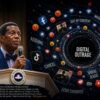
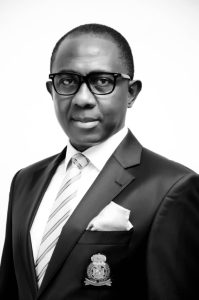
The past few weeks have seen the General Overseer of the Redeemed Christian Church of God (RCCG), Pastor Enoch Adejare Adeboye, in the eye of the storm with his name and that of the church trending across Nigeria’s digital public square. He has been accused of maintaining what the “digital mob” calls a partisan, “strategic silence” in the face of the country’s current uncertainties under President Bola Tinubu. Many are contrasting the perceived silence with his past behaviour. Understandably, the digital outrage against the octogenarian clergy has focused on his immense influence and status as a statesman, but quite typically misses the point about the unique ways in which new media decontextualises the past and how these fits into contemporary political grievances.
So that there is no confusion at all; I must state that I attend the RCCG but this is not an official response on behalf of either church or Adeboye who has spent the last few weeks being “roasted,” “defended,” and “dissected” over an event that, by most accounts, did not happen the way anyone remembers it. We already know that the new media environment is brutal in its design – rewarding anger, punishing nuances and running off before facts can be established. Just take a look. Every week, there is a new villain, a new hero, a new scandal. The ecosystem seems to be impatient where accuracy is concerned – it cares about expediency.
Regardless, it’s important to know that the attacks are straightforward even if the logic is not. Adeboye marched against President Goodluck Jonathan in 2010 but refuses to do the same now; the insinuation being that it is because President Tinubu is Yoruba. For effect, a photograph of the elderly pastor carrying a placard is circulating as evidence of hypocrisy. The implication is damning – he spoke when his political interests were not aligned, but now, he has nothing to say. At face value, the accusation appears reasonable. Here is a “big” religious figure who claims moral authority over millions of Nigerians refusing to lend his influential voice to the criticisms against President Tinubu as the nation groans under economic hardship and insecurity. Or so the narrative goes. Still, the problem with this “attractive” story is that it collapses under the weight of its own omissions.
The image making the rounds is from a “prayer walk” organised by the Pentecostal Fellowship of Nigeria (PFN) and the Christian Association of Nigeria (CAN), in February 2020 “to pray” about national insecurity. It was not even designed to issue political demands to President Muhammadu Buhari who was in power at the time. The placard Adeboye carried did not name Jonathan or Buhari. It simply said, “All Souls Are Precious to God.” Here is what I think: It really is not about whether Adeboye marched but rather about how it appears as if the entire country is collectively misremembering an ecclesiastical directive as an act of political defiance.
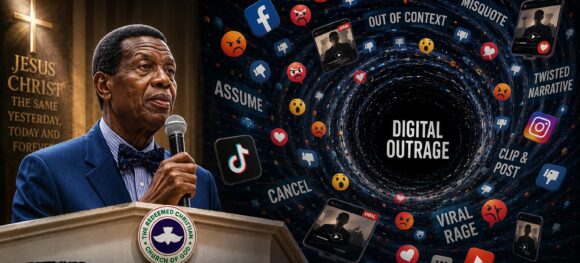
Whichever way one choses to answer this question will be less about the man of God but about the “black hole” of Nigeria’s new “toxic” media information ecosystem. I am using the concept of the “black hole” metaphorically of course to convey the “uniquely crazy” form of digital culture. Such is the unique nature of this space that once you feed in any information, the gravitational pull of outrage colours it and crowds out meaningful discourse. You can expect the digital mob to be passionate but expecting them to be sensible is asking for too much. By conflating the 2010 written petition and the 2020 Buhari-era prayer walk, the digital mob flattened the timeline and constructed a false picture of hypocrisy.
Maybe the mob has its reasons. No doubt, Nigerians are exhausted – having to deal with the rising cost of living; insecurity hand a political class that appears to be struggling to govern. So, when people look around, they probably see religious leaders as the last remaining institutions with moral credibility, which is why when those leaders behave like religious leaders rather than opposition politicians; when they pray instead of protest, when they speak from pulpits instead of podiums; ordinary Nigerians feel betrayed. Unfortunately, it seems that ‘balancing’ both conflicting roles is near impossible in the “black hole,” which is why the public relations disasters plaguing the Pentecostal churches are not that surprising. Look closely and you would see that the church is missing it in a few ways.
One, the church has historically set up for localised, contextual communication, meaning that gospel ministers could prepare their sermons to address the psychological and spiritual needs of their members; mount the pulpit and deliver it. With that communicative architecture, the church was a sanctuary – a literal and metaphorical cocoon where the “language” was protected by walls of mutual faith and institutional loyalty. However, the new media ecosystem has permanently shattered this cocoon. So, for instance, when Pastor Paul Adefarasin of the House on the Rock uttered a politically charged statement – that “Nigeria is dead” – within the physical confines of his cathedral, that statement did not remain in the sanctuary.
In the age of smartphones, live streaming, and decentralised digital distribution, the pulpit is no longer a private altar; it is a global, unedited broadcasting station. Yet, the online responses to Adeboye for his “silence” and Adefarasin for his explicit, “fatalistic hyperbole” exposes the fatal flaw in how modern religious institutions view their communication channels – the naive belief that the church still operates within a closed cocoon. I sense that in treating social media as a mere broadcasting tool to further the gospel rather than a war room, the church’s defensive responses consistently run into PR disasters. The corporate world knows this and appears to be structurally better prepared to deal with headwinds.
Two, structurally, we can identify two types of institutional leadership within the church – those who lead decentralised, bureaucratic organisations, and those whose ministries are built entirely on the charismatic authority of a singular spiritual figure. The Pentecostal movement belongs heavily to the latter. That is the risk; because “the brand” of the church is entirely synonymous with the person of the General Overseer, any statement including political commentary, perceived silence, or social stance by the leader is interpreted as institutional policy. What we have as a result is a hyper-centralised vulnerability. Communication professionals in the corporate world understand this and so, when a brand experiences a crisis, it deploys well-drilled crisis communication protocols. Unfortunately, when a mega-church experiences a crisis, the arrow flies straight to the heart of its spiritual head.
Three, the church’s historical reliance on volunteers rather than professional practitioners to manage communication is another glaring operational vulnerability exposed by this latest controversy. For churches, which prefer spiritual alignment and internal loyalty over professional media expertise, there is always the risk of PR disasters. In the era of traditional media, this model worked perfectly; the church media department was merely a bulletin board meant for broadcasting sermons to a friendly, internal audience. However, contemporary churches are committing fundamental errors by still treating the digital public square as an extension of their congregation. It is not. The moment church programmes are livestreamed and sermons are digitised, communication is instantly stripped of its pastoral context, its spiritual nuance, and its theological framework, leaving it completely exposed to a cynical, secular, and hyper-partisan public square. From what we are seeing, it is safe to believe that a volunteer-driven apparatus is structurally unequipped for the velocity of digital warfare.
In the black hole of Nigerian social media, the appetite for scandal always outstrips the supply of fact. This asymmetry reveals that the public’s grievance is not actually about what the pastors say or do not say. Rather, it is about how their social capital can be weaponised in ongoing political warfare.