TikTokers In Banking Halls: Why Nigerian Banks Are Losing The Trust War

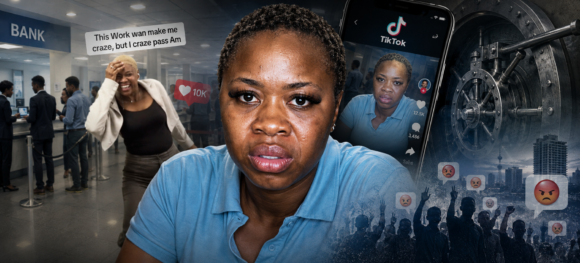
The fact that the digital mob spent a whole weekend “dragging a bank” for taking action against one of its staff who misused social media on-premise should leave no one in doubt that in the ever-evolving landscape of online communication, lines are blurring. Full disclosure at thit point: I worked in Zenith Bank for 13 years as a corporate communications specialist but I do not have the bank’s approval to speak on this matter. As usual my interest is in the digital culture that raises a young woman who believes her job as a banker does preclude her from using her office – including her banks vaults as prop for selfies. To stay silent would be to encourage other ill-informed and poorly-trained, young men and women who want the dignity and discipline of a corporate career but still want to be allowed to maintain the visible but chaotic lifestyle of a content creator.
From viral challenges to influencers vying for likes and shares, clout-chasing is far more destructive that most people would like to admit. In addition to messing up the psyche of those whose livelihood and wellbeing depends on it, there is a real chance that if allowed, it could destroy what is remaining of public trust in corporate institutions. We know Nigerian youth mirror global patterns, spending several hours daily on platforms like YouTube, TikTok, and Instagram Reels. For this demographic, social media is no longer just a pastime – it is an aspirational pathway. Regardless, the growing belief that nothing – inculding bank vaults – is sacred when some clout-chasing, content creating youth is on the payroll should worry right-thinking people.
The Becca Oluwabukola’s Case is typical of a collision of two worlds. The young woman, known online as “GRWM Becca,” worked as a bank teller at Zenith bank in Nigeria. She began creating content in 2018, and by publicly-available accounts often arriving at the office as early as 6:30 a.m. to film because she lacked a suitable recording space at home . The first incident occurred in July 2022 when she posted a video joking about a salary increment she considered “outrageously low.” The bank cited its social media policy and disciplined her. She was suspended, then reinstated, and ironically “converted to permanent staff” shortly after – a fact she noted as irony . Her name surfaced again in 2026. Becca received “several warnings” for posting videos on TikTok. She did a vlog and was summoned for videoing her office area. She took the video down. A week later, she received another query alleging “inappropriate exposure of the bank’s sensitive area” . She appeared before a disciplinary committee, apologised, and later received a call informing her she had been asked to “resign effective immediately” . This is not an isolated story. The social media ecosystem is saturated with videos of bankers filming themselves on bank premises – and Becca noted that she is not the only one filming these spaces. That is scary but not totally surprising.
To understand Becca’s case, one must understand the strength of the motivation. Nigeria’s youth have embraced the creator economy as many young people are forced to innovate in the face of economic hardship, unemployment, and shrinking opportunities . Unlike conventional industries that often require capital or connections, the attention economy lowers entry barriers: a smartphone, internet connection, creativity, and consistency can now create economic opportunities that previously seemed impossible .
Byung-Chul Han’s framework for understanding this compulsion is a bit unerving for me but his argument that we live in a time when demand for total visibility has become an economic imperative, is helpful here. The “pornographication” of society – that compulsion to make all things explicit, visible, and stripped of all nuance, he argues, . erodes the boundary between what should remain private and what is put on display. Becca was not just filming her workplace. She was participating in a culture that rewards total visibility, regardless of context or consequence. This is the quiet rebellion of the attention economy: young professionals using the only tool available to them – visibility – to push back against institutions long-regarded as custodians of tradition. Becca’s TikTok should not be seen just as content. It resembles a form of resistance.
What was once a top-down, gatekept ascent to celebrity – controlled by record labels and television stations – has evolved into a lucrative, bottom-up ecosystem. Anyone with a platform can build an audience and monetise attention . For young people facing high unemployment, influencing has become a legitimate career path. Maybe even more attractive than banking. For young professionals, the attention economy presents an irresistible proposition: visibility is attainable, fame is accessible, and influence is monetisable. The “dream job” is no longer a traditional corporate career but the influencer lifestyle . This creates a fundamental tension. The workplace – particularly in banking, where regulatory obligations demand confidentiality – operates on a different logic: control, hierarchy, and discretion. The attention economy, by contrast, values visibility, authenticity, and personal branding. The friction between these two worlds is where communication governance gaps become exposed.
Becca’s case would be merely an HR curiosity were it not for the deeper crisis it illuminates: Nigerian banking is losing the trust war. Watching a bank “harrassed” by the digital mob underlines the need for a more critial look at the issues. Between March and August 2025, Nigerian banks and fintech companies accounted for 4,615 complaints, representing the highest volume of consumer grievances across all sectors of the economy . The FCCPC resolved over 9,000 complaints and recovered more than ₦10 billion during this period . Fraud losses paint an even more alarming picture. Financial institutions lost N52.26 billion to fraud in 2024, up sharply from N17.67 billion in 2023 . While the number of fraud cases declined in 2025, actual losses remain staggering at N25.85 billion . Social engineering accounted for 47 per cent of total fraud volume and N17.84 billion in losses . The KPMG 2025 West Africa Banking Industry CX Survey reveals the trust consequences: only 33 per cent of customers feel very secure about how their digital transactions are handled, while 53 per cent do not fully trust their bank’s digital platforms. As KPMG notes, “Security has moved from a backend compliance requirement to a frontline customer experience issue” . Customers are increasingly dissatisfied with reactive approaches that focus on dispute resolution after losses occur. Instead, they want banks to embed preventative safeguards directly into everyday banking journeys.
Becca’s case reveals governance failures that Nigerian banks must urgently address – failures that are inextricably linked to the broader trust deficit. First, the absence of clear, communicated policy. Becca claimed she reduced workplace-related posts after understanding the bank’s concerns. Yet she continued filming at the office – suggesting two things – either the the policy did not clearly distinguish between acceptable and prohibited content or she was so desperate as to be willing to ignore. Second, inconsistent enforcement. Becca noted that “the social media is saturated with videos of bankers filming themselves” . Inconsistent enforcement breeds resentment and signals that policy is arbitrary, not governed. Third, the “personal versus corporate” boundary is undefined. Becca’s story revealed why young employees blur the line: she lacked a recording space at home. She filmed at the office early in the morning because she had no access to her phone during official hours.
The deeper issue is that the attention economy will continue to make these collisions inevitable. First, the line between personal and professional digital identities has blurred. Nigerian youth are not just passive consumers – they are producers, curators, and entrepreneurs. For many, their online identity is as important as their professional identity. They see no contradiction between working in a bank and building a TikTok following. Second, the pursuit of attention is intensifying. The attention economy’s algorithms reward engagement, not nuance. The desire for visibility drives young professionals to push boundaries, not because they are reckless, but because the system rewards it. Third, the monetisation of attention creates perverse incentives. When a young person can earn more from a viral TikTok than from months of bank salary, the risk-reward calculation changes. The challenge for institutions is not to outlaw the pursuit of attention, but to govern its expression.
The cost of failing to govern communication is measurable – and it is rising. The banking sector, according to the SenateSHJ Crisis Index 300, is among the most vulnerable to reputational crises, suffering an average 37% share price drop following such events. Recovery, when it happens, takes an average of 741 days – over two years. In Nigeria, the urgency is amplified. The CBN’s 16-day fraud-refund rule has transformed reputational risk into a quantifiable, time-bound balance sheet liability. In this environment, a viral TikTok video featuring a bank’s “sensitive area” is not just an HR issue – it is a regulatory risk and a reputational exposure. Banks might not be able to ban employees from participating in the attention economy. But they can – and must – provide a governance framework that protects the institution while respecting employees’ digital lives.
Becca Oluwabukola’s story is not an anomaly. It is the logical endpoint of a cultural collision between the attention economy’s lure of visibility and the corporate workplace’s demand for control. Nigerian banks cannot afford to treat such cases as isolated HR incidents. They are symptoms of a governance gap that, if left unaddressed, will only widen as more young professionals pursue digital fame alongside corporate careers – and as public trust in the financial system continues to erode. The question is not whether Nigerian banks need communication governance. The question is: who will define the standard?