The Facebook Bleed: Nigeria’s Biggest Banks Are Losing an Audience Nobody Is Tracking

First Bank posts twice a day on X.
It lost 16,614 Facebook followers in 14 days.
Access Bank posts twice a week.
It lost 2,532 in the same period.
I audited the official social media presence of Nigeria’s five biggest banks. Native counters. Verified accounts. No estimates. The pattern that emerged is the opposite of what I expected, and it raises a question that boards should be asking their risk committees.
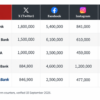
Two weeks ago, I published a data audit of the five banks. The highlight of that finding was obviously the YouTube gap: First Bank, with 4.6 million Facebook followers and 1.2 million on Instagram, had just 11,200 YouTube subscribers. GTBank, by contrast, had 168,800.
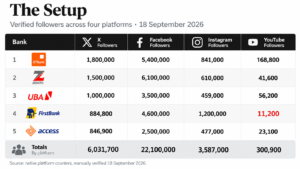
That piece asked whether the banks were building for the next decade or defending the last one. What I did not have then was the data to answer a harder question. Not whether the banks were failing to grow, but whether they were already shrinking.
This index answers that.
Between them, over 30 million followers across four platforms. Reach is not the problem. Reach has never been the problem.
The Question Nobody Is Asking
One of the responses to the first piece, by Moses Anyanwu, Head of Marketing and Growth at GORRO, put the problem more precisely than the original article did: “Follower count can create a false sense of digital strength. A bank can have millions of followers and still have relatively little presence on a platform that serves a completely different function. YouTube isn’t just another social channel. It is also a search engine, an education platform and an evergreen content library. Someone searching ‘how to open a business account,’ ‘how to receive money from abroad’ or ‘how to manage a business loan’ can discover a useful video months after it was published. So the question may not really be, ‘How many followers does the bank have?’ It may be: what role does each platform play in the customer’s journey, and are we building for that role?”
That is the question this index attempts to answer. Not how many followers, but what each platform is for, and whether the banks are building accordingly.
Finding One: Engagement Is Platform-Specific
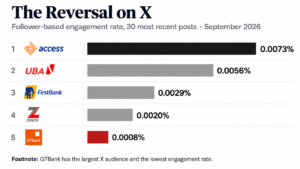
On X, Access Bank has the highest engagement rate of the five at 0.0073%. GTBank, with the largest following, has the lowest at 0.0008%. The biggest audience talks back the least.
On Instagram Reels, the ranking inverts. UBA leads at 0.29%. Access Bank sits near the bottom at 0.034%.
There is no such thing as a bank that is good at social media. There are banks that are good at particular platforms and poor at others. Access Bank owns X. UBA owns Instagram. GTBank owns reach. Nobody owns the conversation everywhere.
For marketing leaders, this is the finding that should challenge your assumptions. A single content strategy deployed across all platforms is a strategy that underperforms on most of them. The audience on X and the audience on Instagram behave differently, reward different content, and are not interchangeable. Treating them as one audience is not a channel mistake. It is a category mistake.
Finding Two: The Posting Paradox
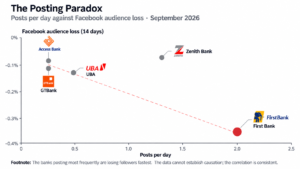
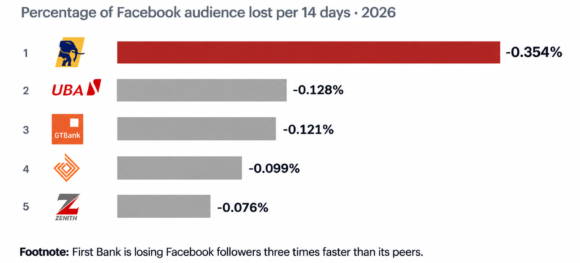
First Bank posts more than twice as often as any other bank on X. It also loses Facebook followers three times faster than any other bank in the group.
Access Bank posts least and loses followers most slowly.
The correlation is consistent. The data cannot tell us whether posting volume is a cause, a symptom, or a coincidence. It can only tell us that the conventional wisdom — post more, engage more — is not holding for these five banks.
The banks doing the most talking are bleeding the hardest. Volume is not stemming the decline. On this evidence, it may be accelerating it.
Finding Three: The Facebook Bleed
Every tier-1 Nigerian bank is losing Facebook followers. Not some. All five.
Four of them are losing at rates between 0.076% and 0.128% per 14 days. That tight clustering suggests a platform-wide effect rather than a bank-by-bank failure. Facebook is aging, and the audience Nigerian banks spent over a decade assembling there is migrating to TikTok, YouTube, and Instagram.
First Bank, at 0.354%, is an outlier. Whatever is happening at Facebook is happening everywhere. Something additional is happening at First Bank.
This is where the conversation shifts from marketing to governance. A bank that is losing 0.1% of its audience every fortnight is losing roughly 2.5% per year. Over a five-year horizon, that is a material erosion of a channel the institution has come to depend on. The question to ask is – do banks have a plan for this? Are boards looking at these figures and asking the right questions? Do risk committees receive these kinds of briefings? Do they even track social platforms? These questions could help address the gap.
Finding Four: The Unexplained Spike
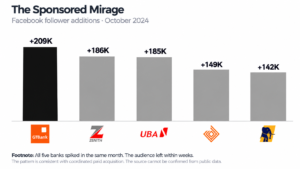
In October 2024, all five banks gained Facebook followers simultaneously and by large margins.
Almost 900,000 additions across the sector in thirty days. The pattern is consistent with coordinated paid acquisition, though the data cannot confirm the source. What it does confirm is that whatever was gained in October 2024 did not last. Every bank resumed its decline within weeks.
The marketing implication is direct. Audience acquisition without engagement design is expenditure, not investment. The followers arrived, and they left, because nothing was built to keep them. Any CMO reading this should be asking their Comms team what happened to the audiences they paid to acquire in the last two years.
Finding Five: The Human Face Deficit
The banks with the strongest video engagement have identifiable people in front of the camera. GTBank through NdaniTV. UBA through RedTV and Red Radio, though the connection back to the parent brand is weaker.
The banks without them — Access, Zenith, First Bank — are broadcasting through a faceless corporate account and wondering why engagement stays low.
For brand and content leaders, this is the operational finding. People subscribe to people, not to logos. The banks without identifiable faces are not just underperforming. They are structurally disadvantaged in a medium where personality is the primary unit of attention. This is a hiring question, not just a content question. Who carries your brand’s voice?
Finding Six: The YouTube Gap Is a Search Problem
YouTube is not another social channel. It is a search engine, an education platform, and an evergreen content library. A customer searching “how to receive money from abroad” or “how to avoid a transfer scam” is not looking for a bank. They are looking for an answer. The bank that owns the answer owns the customer before the customer knows they are a customer.
A Facebook post is seen once and disappears. A YouTube video is discovered repeatedly, for years, by people actively seeking the information it contains. The first is a broadcast. The second is an asset.
This is why the gap matters more than the follower numbers suggest. First Bank has 1.2 million Instagram followers and 11,200 YouTube subscribers. That is not a 100-to-1 ratio of audience preference. It is a 100-to-1 ratio of strategic attention. The bank is investing where the audience is loudest and neglecting where the audience is looking.
For context, I will take the feedback from the first piece from Chinaza Anyaegbunam, who led design at Zenith Bank’s Digital Factory, offered the missing link. The video gap is not only a content problem. It is a product problem. As he put it: “You can’t explain a confusing journey well on camera.” Banks whose account-opening flows are difficult, whose apps require four verification steps, and whose customer journeys are not legible cannot produce sixty-second videos that teach them. The content failure is downstream of a design failure. The YouTube gap will not close by hiring better agencies. It will close when the products themselves become simple enough to explain.
Another insight by Olaolu Oretade, is equally useful here: that banks shy away from visibility because visibility invites scrutiny. If that is true, the YouTube gap is not a failure of effort. It is a defensive posture. Either way, the exposure it creates is the same.
Why This Is a Risk Issue, Not a Marketing Issue
There is a temptation to read all of this as a content strategy problem. It is not.
When a bank faces a viral complaint, a data breach, an outage, or a fraud allegation, it needs to speak directly to its customers, at scale, immediately. It needs a channel it owns, with an audience that trusts it. If the primary audience sits on a platform that is shrinking, and the bank has no meaningful presence where attention is migrating, it is structurally exposed.
A strong channel is not a marketing expense. It is insurance against the day you need to be heard and nobody is listening.
This is not hypothetical. OPay’s recent reputational incident showed how quickly a narrative can be shaped by people who do not work for the institution at the centre of it.
David Abiodun, an enterprise technology leader with experience across UK, Singaporean and Luxembourg regulatory environments, offered the clearest articulation of the operating model this argument requires: clear business ownership in Communications or Marketing, Technology accountable for secure access and recovery, Risk and Compliance involved in oversight and crisis planning, and — most importantly — a named accountable owner supported by documented and tested access, handover and escalation processes.
That last condition is the one Nigerian institutions most often fail to satisfy. The loss of a single person or agency relationship is not a marketing inconvenience. It is an operational continuity risk that has not been documented and has not been tested.
This is the finding that should be escalated to the board. Marketing owns the channel. Risk owns the exposure. The two functions have not been talking to each other on this question, and the data shows it.
What This Means
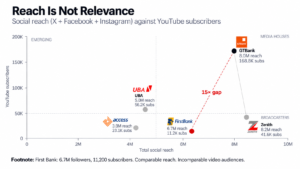
Reach is not relevance. Volume is not engagement. Acquisition is not affinity.
Nigerian banks have spent over a decade building audiences on platforms that are now losing those audiences, and they have spent the last five years under-investing in the platforms where attention is migrating. The result is a structural exposure that is invisible on a follower count but unmissable in the underlying data.
I particularly like the insight provided by Sohail Malik, an IBA-certified independent director and CEO, who readd the first article. He put the closing argument better than I could: this is “institutional work, not only a campaign budget.” And, as he added, “distribution without a clear digital operating model rarely closes the gap.”
The banks that close this gap will not be the ones with the most followers. They will be the ones that put human beings in front of the camera, build content that people choose to watch, and treat their channels as products rather than noticeboards.
The question for every board, every CMO, and every Chief Risk Officer is simple. When the next crisis arrives, where will your customers hear it from? If the answer is not a channel you own, you have a problem.
Methodology: Reach figures verified manually against native platform counters on 18 September 2026. Engagement rates calculated from the 30 most recent posts per platform in September 2026, using (likes + comments + shares) ÷ (followers × posts) × 100. Facebook trends drawn from Social Blade’s most recent 14-day window per bank; because windows do not align, change is expressed as a percentage of starting audience. Customer responsiveness and TikTok were excluded from this edition due to scope and data availability respectively. Both will be included in the next iteration. All five banks were contacted for comment on 19 September 2026. No responses received.
I am publishing this audit quarterly. If you want the next edition in your inbox, follow me here.
If you want this analysis applied to your institution, my inbox is open.